CEO
Whether or not a business pays the ransom, most never recover all their data. The real difference comes from preparation and recovery planning, not the payment decision itself.
When ransomware locks down a network, the costs stack up fast: halted operations, lost revenue, and data that may never come back. Ransomware recovery is usually framed as a single choice—pay the ransom or refuse—but that framing hides most of what actually matters.
Refusing to pay feels like the responsible move, the one that protects both data and reputation. Yet even businesses that do pay recover all their data only 13% of the time, which means payment was never the variable that decided the outcome. What happens before and after the attack decides it instead.
Seen that way, ransomware recovery stops being a yes-or-no moment and becomes a process, one that tests how well a business planned, prepared, and built the capacity to restore what it lost. Knowing which parts of that process actually work separates a full recovery from a long, expensive shutdown.

Most advice about ransomware attack recovery centers on the payment question, and that focus pulls attention away from the decisions that actually determine how the attack ends.
Paying rarely settles the matter cleanly. Attackers may hand over a decryption key that fails, or one that restores only a fraction of the encrypted files. Refusing to pay doesn't settle it either, since a business still needs a working plan to get systems running again regardless of which choice it made.
So the payment decision was never the real issue — readiness was. Businesses fixated on whether to pay often skip past the groundwork that actually brings systems back online, which leaves them improvising at the exact moment they can least afford to.
The recoveries that go well tend to share a different focus entirely: reliable backups, a documented recovery plan, and security practices built before trouble starts. Those three things carry more weight than the payment decision ever could.
Once an infection hits, the response a business can mount reflects the work already done beforehand. The businesses that come out ahead aren't simply the ones that held the line on payment — they're the ones that had already built a foundation strong enough to recover on.
Backups are the backbone: secure, recent copies kept isolated from the main network let a business restore its own data instead of waiting on attackers to make good on a promise. That single factor often separates a short outage from a prolonged one.
A clear recovery plan removes the guesswork: who acts, in what sequence, with which tools. Without that clarity, even solid backups can sit unused or get restored in the wrong order.
Testing the recovery process regularly is what confirms the plan actually works — that the team knows how to use the backups, that systems restore cleanly, and that nothing critical was missed.
Security team coordination ties it together, since a prepared team can contain the spread, drive the technical recovery, and manage communication with stakeholders at the same time.
In California, where privacy regulation is especially strict, having all four pieces in place carries extra weight — it protects sensitive data while also keeping the response inside legal bounds.
The numbers settle the question the pay-or-don't-pay debate leaves open. Many organizations still pay, hoping for a quick resolution, yet only a small share recover all their data even after paying.
That gap exposes the risk in treating payment as a recovery strategy: attackers may not deliver, leaving a business facing the same data loss and downtime it hoped to avoid, only poorer. Prevention, preparation, and dependable recovery tools offer a far better shot at getting operations back.
Weighing how to recover from ransomware comes down to two practical questions: are the backups genuinely separate from the main systems, and can they be restored quickly when needed? Those answers matter far more than any hypothetical about paying a ransom.
Beyond the payment decision sits a sequence of actions that actually drives recovery once an attack has happened.
Disconnecting infected devices from the network immediately stops the ransomware from reaching other computers or servers.
Pinpointing the strain in play reveals which decryption tools or recovery options might actually exist.
Checking which files and systems were encrypted shows what's at risk and which recovery efforts to prioritize first.
Bringing in IT or security experts early keeps the response coordinated and ensures no step gets missed.
The most recent clean backup should be used to recover critical data, after confirming the backup itself isn't infected.
Once recovery is complete, testing confirms the systems work properly and that no malware remains behind.
Patching vulnerabilities and updating the incident response plan turns the recovery into a defense against the next attempt.
Given that sequence, the payment question fades next to a more concrete factor: the quality of the backup and recovery systems already in place, which let a business restore data without any dependence on the attackers.
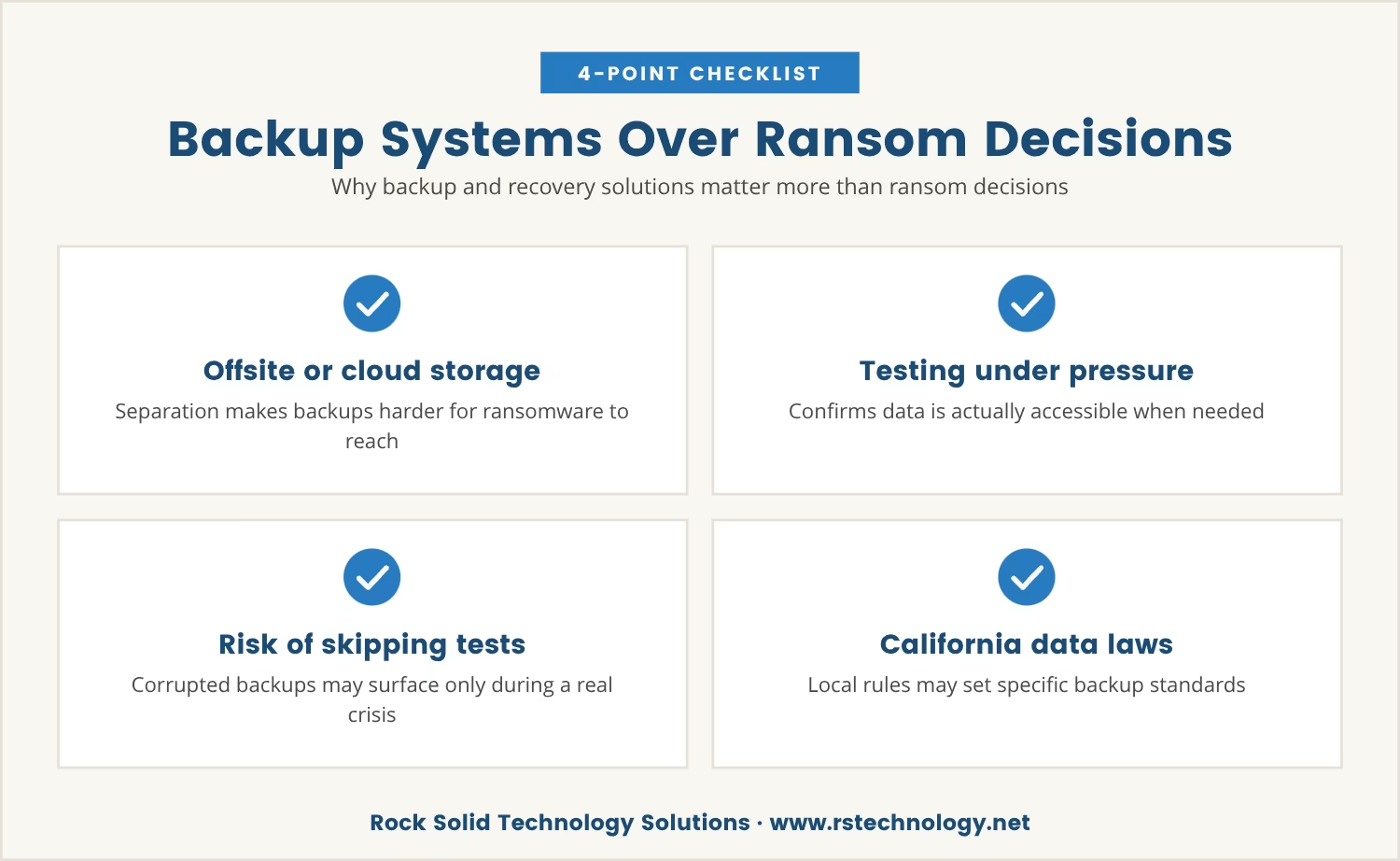
Modern backup systems store copies offsite or in the cloud, physically separate from the main network, which makes it far harder for ransomware to reach and encrypt them. When those backups are current and reliable, recovery can happen fast.
Having the tools, though, is only half the equation — the other half is making sure the data can actually be accessed and used under pressure, which is what regular testing confirms. Skip that testing, and a business may not discover its backups were incomplete or corrupted until the moment it needs them most.
Businesses operating in California carry an added layer here: local data protection laws that may require specific backup or recovery standards. Meeting them does double duty, satisfying compliance while reinforcing the broader security posture.
Even a solid recovery plan can stall if these common mistakes creep in:
Steering clear of these mistakes keeps the recovery process shorter and far less painful.
Across all of this, the real dividing line between a full recovery and a partial one was never the payment decision — it was the strength of the preparation behind it.
Businesses that invest in regular backups, a documented recovery plan, and strong security measures tend to restore operations quickly, while those that treat refusal to pay as their entire strategy often find themselves unready for the actual work recovery demands.
Protecting a business, then, means focusing on the steps that genuinely restore data and systems. Payment belongs at the end of that list, as a last resort — never as the plan itself.

If you’re responsible for 15 to 70 users, you know that a ransomware attack can disrupt your entire operation. At Rock Solid Technology Solutions, we understand how stressful it is to face these threats and the pressure to make the right call.
We invite you to see how we approach ransomware recovery—starting with a conversation about your current setup and what it would take to restore your data, no matter what decision you face.
You can try our services with no long-term commitment—leave anytime we stop delivering results for your business.
A backup is safest when stored separately from the main network, such as on an offline device or in a secure cloud service. Testing it regularly and keeping it isolated from daily operations keeps it protected even if the primary network is compromised.
The plan should name who to contact, how to isolate infected systems, how to communicate with staff and stakeholders, and the exact steps for restoring data. It should also include a checklist for any legal or regulatory notifications required when sensitive data is involved.
Paying remains risky and offers no guarantee of full data recovery. Some businesses weigh it only when no backups exist and the encrypted data is critical, though even then the outcome is uncertain and payment can invite further attacks.
Recovery time hinges on how far the attack spread, how solid the backups are, and how smoothly the recovery plan gets executed. Strong preparation can bring systems back within hours, while its absence can stretch recovery into days or longer.
Keeping software updated, enabling multi-factor authentication, training staff to recognize phishing attempts, and maintaining regular, isolated backups all strengthen protection. Regularly reviewing and updating security policies further reduces the risk of a repeat incident.

Dan Gross brings nearly 30 years of experience in technology integration, IT support, and cybersecurity. As the leader of Rock Solid Technology, he helps businesses leverage technology to improve operations, strengthen security, and solve complex IT challenges. He is also a sought-after IT conference speaker, sharing insights on technology, leadership, and business.