CEO

The outcome of a CMMC assessment is shaped by IT, HR, legal, and mailroom teams—often without leaders realizing it. Leaving any one out of planning creates a gap that assessors will catch and budgets rarely cover.
A CMMC assessment rarely hinges on one dramatic technical failure. More often it comes apart through small oversights scattered across different teams, each one invisible until an assessor starts asking questions.
A single group left out of the planning can sink an otherwise strong assessment, even when every other area looks solid on paper. That's because the process covers far more than technology: it reaches into people, processes, and even how physical mail gets handled. A business that focuses narrowly on cybersecurity can still miss requirements that, at first glance, seem to have nothing to do with it.
Recognizing who actually shapes your outcome is the first step toward avoiding that kind of surprise. The sections below walk through the groups that quietly decide whether an assessment passes or fails.

Many organizations in California begin their CMMC journey by concentrating on IT, which makes sense given that so much of the cybersecurity maturity model certification centers on protecting digital information. Even so, CMMC requirements extend well past firewalls and passwords.
IT teams handle network security, device management, and access controls, and they document how systems meet NIST SP 800-171 standards. Technical safeguards, however, don't address every risk on their own.
Consider a business whose HR department skips proper onboarding and offboarding steps: former employees can retain access to sensitive data, a gap no firewall configuration will close. Legal gaps work the same way. When legal teams aren't involved early, contracts can miss critical language about handling controlled unclassified information (CUI) or federal contract information (FCI) — and that omission leads straight to non-compliance, regardless of how secure the IT systems are.
IT remains essential, but leaning on it alone isn't enough, since the scope of CMMC certification touches every part of the business.
IT isn't the only function shaping an assessment's outcome. HR, legal, and the staff who handle physical mail and shipping all play roles that often go unrecognized until something goes wrong.
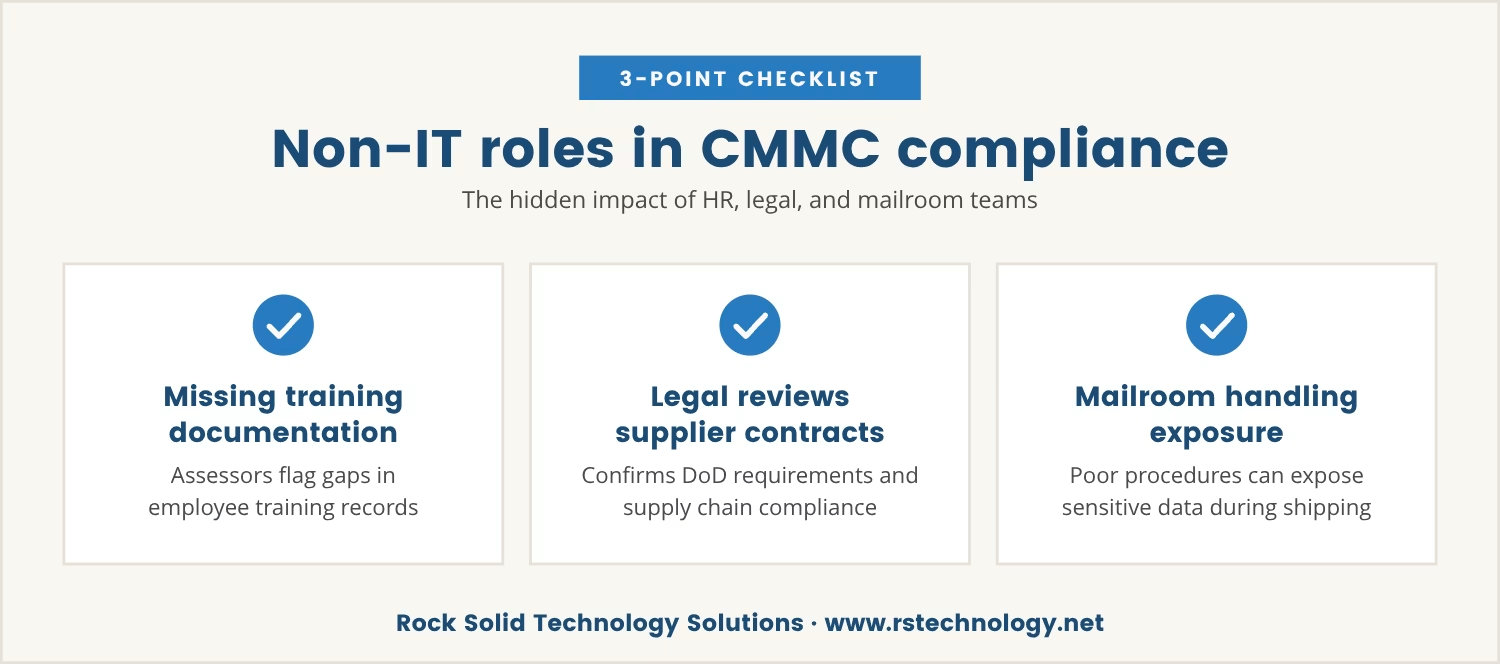
HR manages background checks, training, and access permissions, and inconsistency in any of these can cause a business to fall short of CMMC level 1 or level 2 requirements. Missing documentation for employee training, for instance, is exactly the kind of thing a third-party assessment flags.
Legal teams carry a parallel responsibility: they review contracts and policies to confirm the business meets Department of Defense (DoD) requirements and that suppliers throughout the supply chain are compliant too. A missing clause about safeguarding CUI can turn into an audit problem fast.
Mailroom and shipping staff, meanwhile, handle the physical side of the same risk. Without secure handling procedures, sensitive information can be exposed in transit — a concern that matters especially for defense contractors sending or receiving controlled information by mail.
Each group's actions can open a compliance gap on its own, and those gaps tend to stay invisible until an assessor finds them.
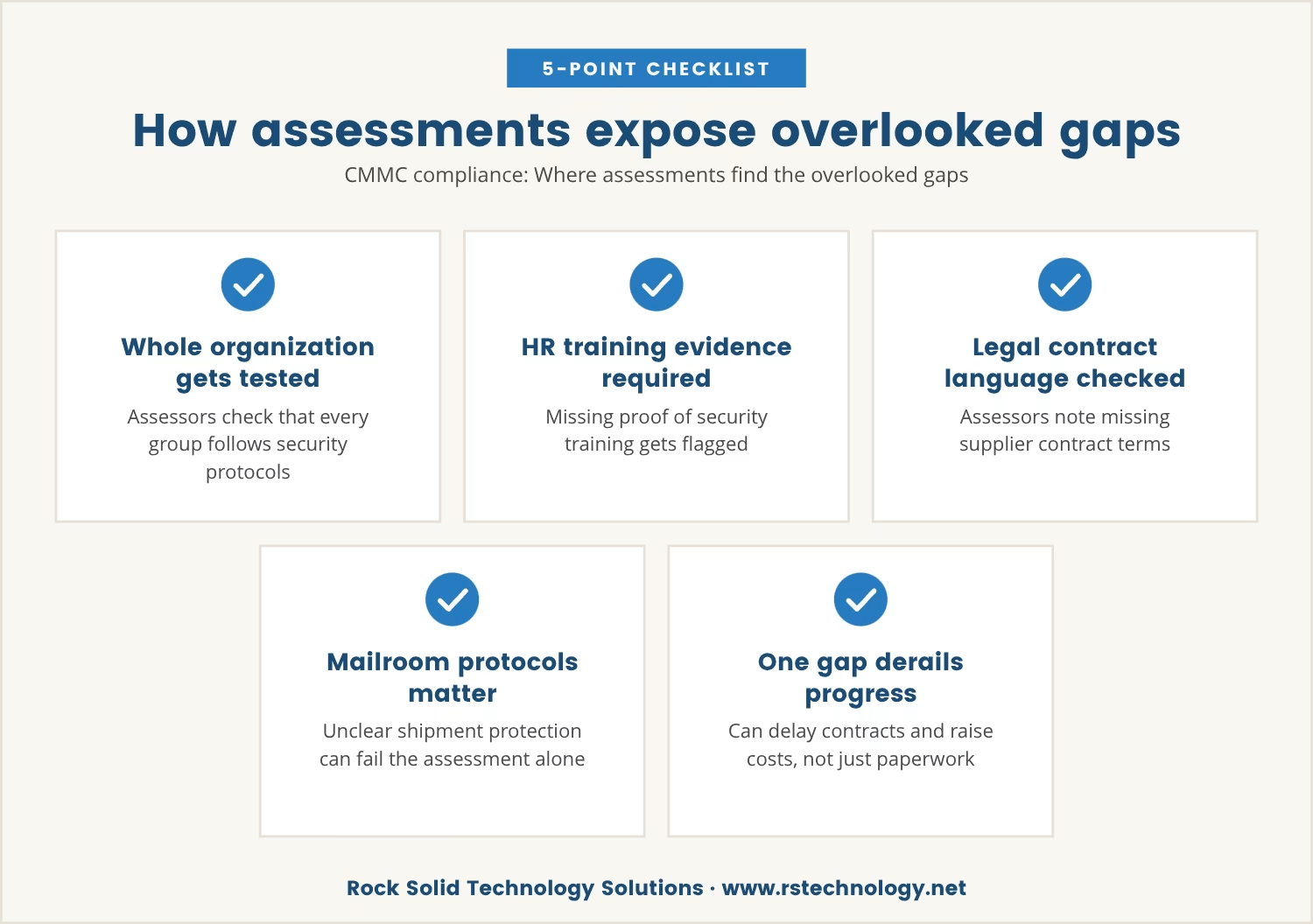
CMMC compliance assessments test the entire organization, not just its IT systems, so assessors look for proof that every group understands and follows security protocols.
That means if HR can't produce evidence of security training, it's flagged. If legal can't show supplier contracts with the right language, the assessor notes it. If the mailroom can't explain how it protects sensitive shipments, the assessment can fail on that basis alone.
In California, businesses often discover during the formal assessment itself that one overlooked group is enough to derail their progress — not merely a paperwork problem, but one that can delay contracts and drive up costs.
The lesson follows directly: every group that touches sensitive information belongs in the assessment planning from the start, because missing even one can open a gap that's difficult and expensive to fix later.
Passing a CMMC assessment means paying attention to four specific groups, each carrying responsibilities that can make or break the outcome.
IT manages digital safeguards, from firewalls to user access, and documents how systems meet NIST SP 800-171 and NIST SP 800-172 requirements. Its records are usually the first thing an assessor checks.
HR ensures employees are properly vetted and trained, managing onboarding, offboarding, and ongoing security awareness. Incomplete records here can lead directly to failed requirements.
Legal teams review and draft contracts to include CMMC requirements and confirm that the business and its suppliers follow DoD rules. Missing or unclear language can cause compliance issues on its own.
Mailroom staff handle the flow of physical documents and packages, safeguarding any controlled unclassified information that moves through the facility. Weak procedures here can expose sensitive data just as easily as a weak digital control.
Leaving any of these groups out of CMMC readiness planning carries real consequences, the most common being a failed assessment that delays or even blocks a business from winning federal contracts.
Picture an IT team that's fully prepared while HR hasn't documented employee training — the assessor finds that gap regardless of how strong the network defenses are. Or legal hasn't updated supplier contracts, leaving the supply chain out of compliance. Or the mailroom lacks a secure process for handling CUI, exposing sensitive information despite everything else being in order.
These failures are rarely dramatic; they're usually small issues that accumulate. Yet each one alone can be enough to stop certification in its tracks.
A successful CMMC assessment starts with a checklist covering every group involved, built around these steps:
Following this checklist helps confirm that a business is truly ready for a third-party assessment.
Businesses in California planning for CMMC certification often budget for IT upgrades and training, yet unexpected costs tend to surface when other groups get pulled in late or when gaps surface during the assessment itself.
Updating contracts or retraining staff after a failed assessment costs more than doing it upfront, and the delays that follow can affect a business's ability to bid on new contracts. Bringing every relevant group in from the start is what makes these surprises avoidable.
A complete approach saves both time and money, and it builds confidence that the business is ready for the demands of CMMC 2.0 and whatever audits follow.

Many businesses with 15 to 70 users focus on IT when preparing for CMMC, only to discover late-stage gaps in other departments. At Rock Solid Technology Solutions, we know how frustrating it is to find out you missed a critical group after the assessment begins.
Let’s talk about how our team approaches CMMC planning across your entire organization, or discuss your current setup to make sure no group is left out.
You can work with us with no long-term commitment—leave anytime we stop delivering real results for your business.
CMMC 2.0 streamlines the original model by reducing the number of levels and letting some businesses complete a self-assessment for lower-risk contracts. Contracts involving controlled unclassified information still require a third-party assessment, and the new version places more weight on documentation and evidence from every group involved, not just IT.
A C3PAO (Certified Third-Party Assessment Organization) is authorized to conduct formal CMMC assessments, reviewing policies, procedures, and evidence to determine whether a business meets the required level of compliance. Its findings decide whether certification is achieved.
Small businesses must meet the same CMMC requirements as larger organizations when they handle federal contract information or controlled unclassified information. The main difference is that smaller teams often need to be more strategic about assigning responsibilities and documenting compliance across all relevant groups.
Each service provider needs to understand both the business's CMMC requirements and its own responsibilities within them. Contracts should state compliance expectations clearly, with documentation collected from every provider to present to assessors, which helps close gaps in the supply chain before they're found.
Untrained mailroom staff put physical documents containing sensitive information at risk, which can fail an assessment even when digital controls are strong. Training and clear procedures for handling physical mail are essential parts of compliance, not an afterthought to it.

Dan Gross brings nearly 30 years of experience in technology integration, IT support, and cybersecurity. As the leader of Rock Solid Technology, he helps businesses leverage technology to improve operations, strengthen security, and solve complex IT challenges. He is also a sought-after IT conference speaker, sharing insights on technology, leadership, and business.